
Extraversion and introversion
A central trait dimension in human personality theory.

RCraig09 · CC BY-SA 4.0
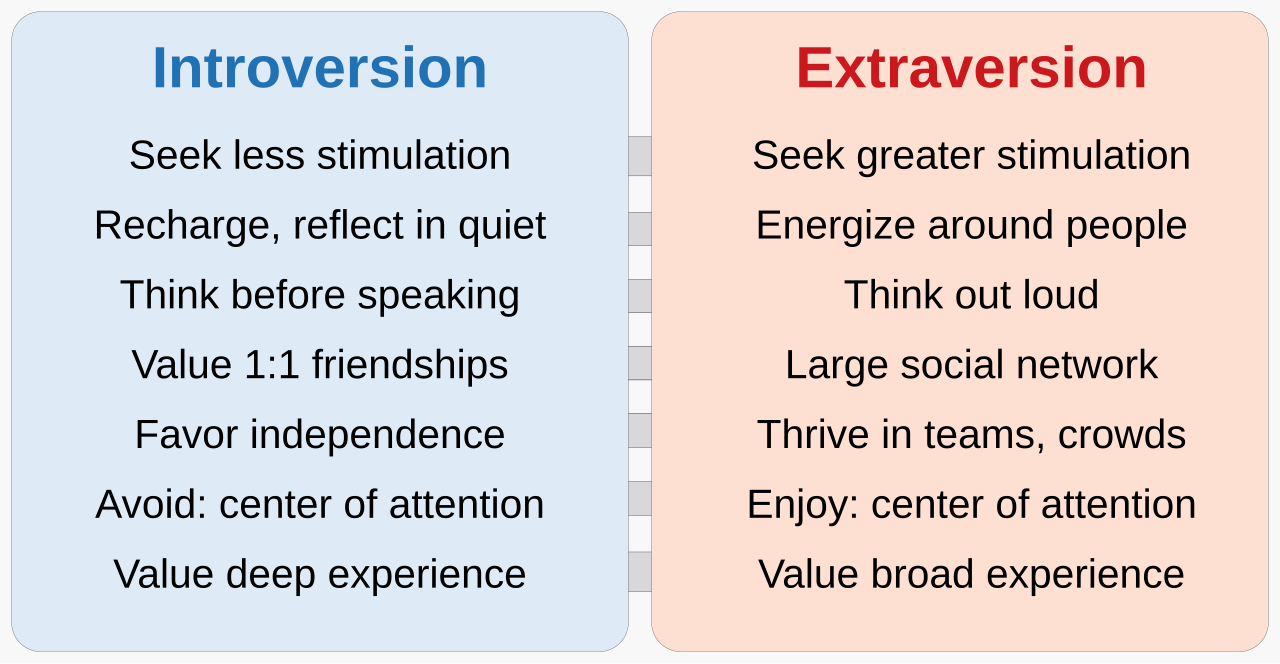
Extraversion and introversion are a central trait dimension in human personality theory. The terms were introduced into psychology by Carl Jung, though both the popular understanding and current psychological usage are not the same as Jung's original concept. Extraversion (also spelled extroversion) is typically associated with sociability, talkativeness, and high energy, while introversion is linked to introspection, reserve, and a preference for solitary activities. In psychology, these are viewed as personality traits that can be measured in degrees, rather than placing people into fixed categories.
- introduced_by
- Carl Jung
- first_use_in_print
- 1910
- first_detailed_description
- 1921 book Psychological Types
- field
- Personality psychology
- key_contributors
- Carl Jung, Hans Eysenck, William McDougall, Edmund Smith Conklin, Adam Grant
- known_for
- Central trait dimension in human personality theory
Lore & Background
In September 1909, Swiss psychiatrist Carl Jung used the term introverted in a lecture at Clark University. A transcript of this lecture was then published with two others in a journal in 1910, the first time the term appeared in print. In the lecture he mentions that love that is 'introverted ... is turned inward into the subject and there produces increased imaginative activity'. His 1921 book Psychologische Typen was published as Psychological Types in English in 1923, describing the 'introverted' in detail for the first time. In his later paper, 'Psychologische Typologie', he gives a more concise definition of the introverted type, writing that such a person 'holds aloof from external happenings, does not join in, has a distinct dislike of society as soon as he finds himself among too many people' and that 'his own world is a safe harbor, a carefully tended and walled-in garden, closed to the public and hidden from prying eyes'. In the 1950s, British psychologist Hans Eysenck theorized that the trait of introversion-extraversion could be explained in terms of Clark Hull's drive theory of motivation. He later developed his own arousal theory to explain individual differences in the trait, suggesting that the brains of extraverts were chronically under-aroused, leading them to seek out stimulation from the environment. Introverts, being more cortically aroused, avoid overstimulating environments. The trait of introversion-extraversion would become one of three central traits in Eysenck's PEN theory of personality. William McDougall discussed Jung's conception, concluding that 'the introverts are those in whom reflective thought inhibits and postpones action and expression: the extroverts are those in whom the energies liberated upon the stirring of any propensity flow out freely in outward action and expression.'
Reader's Guide
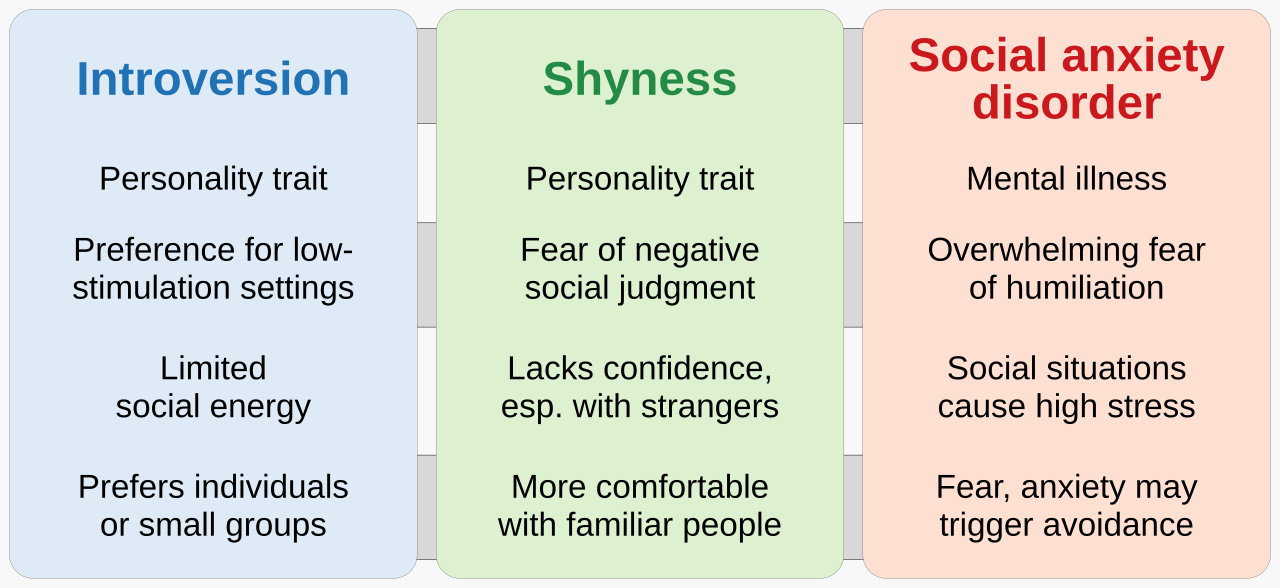
Extraversion and introversion remain a foundational dimension in personality psychology, influencing numerous modern models including the Big Five, Jung's analytical psychology, Hans Eysenck's three-factor model, Raymond Cattell's 16 personality factors, and the Minnesota Multiphasic Personality Inventory. While often presented as opposite ends of a single continuum, personality theorists such as Carl Jung have said that most individuals possess elements of both traits, with one being more dominant depending on the situation. Research has shown that extraversion is considered to be on a spectrum instead of being fixed, meaning people display differing levels of either extroverted or introverted tendencies in many different situations. Mistaking introversion for shyness is a common error: introversion is a preference, while shyness stems from distress. Susan Cain, author of the book Quiet: The Power of Introverts in a World That Can't Stop Talking, argues that modern Western culture misjudges the capabilities of introverted people, leading to a waste of talent, energy, and happiness, and that both introverts and extraverts enrich society.
Did You Know?
- Carl Jung first used the term 'introverted' in a lecture at Clark University in September 1909, with the term appearing in print for the first time in 1910.
- Hans Eysenck theorized that extraverts' brains are chronically under-aroused, leading them to seek stimulation, while introverts are more cortically aroused and avoid overstimulation.
- Susan Cain reported studies indicating that 33–50% of the American population are introverts.
From a Single Lecture to a Foundational Concept
Carl Jung first uttered the word 'introverted' in a September 1909 lecture at Clark University, where he described a form of love turned inward that stirs imaginative activity within the subject. A transcript of that talk appeared in a journal the following year, marking the term's debut in print. The concept matured over the next decade, culminating in Jung's 1921 volume Psychologische Typen, rendered into English in 1923 as Psychological Types. That work offered the first detailed portrait of the introverted individual: someone who withdraws from crowds, feels lost in large gatherings, and treats his inner world as a private, enclosed garden closed to outsiders. Jung contrasted this with extraversion, which he framed as an orientation toward the external object. What began as a clinical observation in a single university lecture thus became one of the most enduring axes along which psychologists have mapped human personality for more than a century.
A Spectrum, Not a Switch
Rather than sorting people into rigid boxes, contemporary psychology treats extraversion and introversion as measurable degrees along a continuum. Most individuals carry elements of both orientations, with whichever trait dominates shifting from one context to another. This flexible, dimensional view has made the introversion-extraversion axis a staple across virtually every major personality framework. The Big Five model, Hans Eysenck's three-factor PEN structure, Raymond Cattell's sixteen personality factors, and even the Minnesota Multiphasic Personality Inventory all incorporate some version of this trait. William McDougall, reflecting on Jung's original conception, captured the distinction neatly: introverts are those whose reflective thought delays and restrains outward action, while extraverts let liberated energy flow freely into expression. The result is a trait dimension that resists simple labeling and instead captures the subtle, situation-dependent ways people draw energy from the world around them or from their own inner life.
The Arousal Hypothesis
In the 1950s, British psychologist Hans Eysenck sought a physiological grounding for the introversion-extraversion split, building initially on Clark Hull's drive theory of motivation. He then developed his own arousal-based account: the brains of extraverts, he proposed, operate at a chronically lower level of cortical arousal, which drives them to seek out external stimulation to reach a comfortable baseline. Introverts, by contrast, sit at a higher resting level of cortical arousal and therefore tend to avoid environments that would push them past that threshold. This elegant neurological framing explained why one group gravitates toward bustling social settings while the other retreats to quiet, minimally stimulating spaces. Eysenck elevated the trait to one of three central dimensions in his PEN theory of personality, cementing its place in scientific psychology. The arousal hypothesis also helped clarify why the same person might behave differently in a lecture hall versus a small dinner party: the variable is not a fixed identity but a dynamic balance between internal and external stimulation.
More Than Shyness
A persistent and consequential confusion in popular thinking is the equation of introversion with shyness. The two are fundamentally different in origin and experience. Introversion is a preference: an individual simply finds greater reward in solitary pursuits such as reading, writing, or meditating, and feels less energized by large social gatherings. Shyness, by contrast, is rooted in distress and fear of social encounters. An introvert may navigate a crowded room without anxiety; a shy person may dread it even if they would enjoy the interaction. Research underscores that extraversion and introversion exist on a spectrum, with people displaying varying degrees of each tendency across different situations. Introverts tend to prefer concentrating on one activity at a time, observing before participating, and thinking analytically before speaking—habits especially visible in developing children and adolescents. Recognizing this distinction matters because it removes the implicit judgment that a preference for quiet and solitude signals a deficit or a fear that needs correcting.
Gallery
Frequently Asked Questions
Who introduced extraversion and introversion into psychology?
Carl Jung coined the terms, first putting them in print in 1910 and then giving a fuller treatment in his 1921 book Psychological Types.
What are extraversion and introversion in personality theory?
They form a core axis along which human personality is described: extraversion leans toward sociability, talkativeness, and high energy, while introversion leans toward reserve, introspection, and a preference for solitary activities.
Are people strictly either an extravert or an introvert?
No—modern psychology treats the two poles as a continuous spectrum, so every individual lands somewhere in between rather than in one fixed category.
Who are the key contributors to the study of extraversion and introversion?
Beyond Jung himself, Hans Eysenck, William McDougall, Edmund Smith Conklin, and Adam Grant have each shaped how the trait is conceptualized and measured in contemporary research.
What field of psychology does extraversion and introversion belong to?
It sits squarely within personality psychology, the branch focused on mapping and measuring stable individual differences in how people think, feel, and behave.
More in Psychology 1-21
Spotted an error? Know more?
This is a living reference — every entry is fact-audited, and reader corrections feed straight into our audit queue. Suggest an edit · See this site's audit record