
Gestalt psychology
School of psychology emphasizing whole patterns over individual parts.

Tuculet2017 · CC BY-SA 4.0
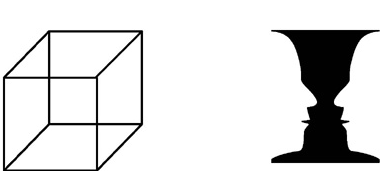
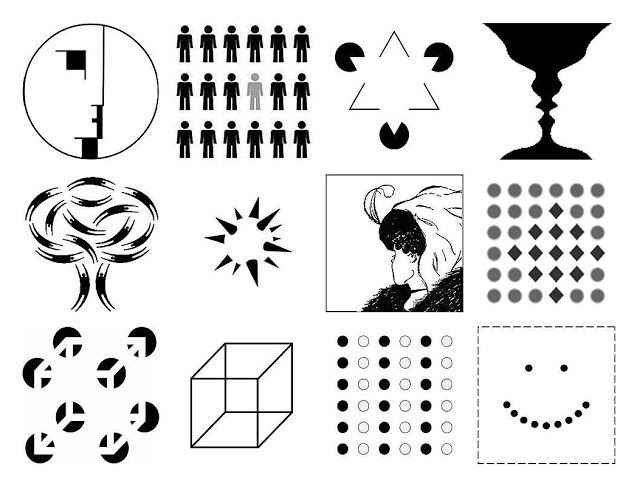
Gestalt psychology, also known as gestaltism or configurationism, is a school of psychology and a theory of perception that emphasizes processing entire patterns and configurations rather than individual components separately. It emerged in the early twentieth century in Germany and Austria as a rejection of the elementalist and structuralist psychology of Wilhelm Wundt and Edward Titchener. The approach is often associated with the idea that the whole is different from the sum of its parts, and it holds that information is perceived as wholes rather than disparate parts processed summatively.
- field
- Psychology, theory of perception
- known_for
- Emphasizing that the whole is different from the sum of its parts; phi motion; insight learning in chimpanzees
- founders
- Max Wertheimer, Kurt Koffka, Wolfgang Köhler
- origin
- Early 20th century, Germany and Austria
- key_concept
- Gestalt (pattern or configuration)
Lore & Background
Max Wertheimer, Kurt Koffka, and Wolfgang Köhler founded Gestalt psychology in the early 20th century. Wertheimer had been a student of Austrian philosopher Christian von Ehrenfels, who introduced the concept of Gestalt to philosophy and psychology in 1890. Von Ehrenfels observed that a perceptual experience, such as a melody, is more than the sum of its sensory components, calling this additional element Gestalt-qualität or 'form-quality.' Wertheimer's unique contribution was to insist that the gestalt is perceptually primary, defining the parts rather than emerging from them. Köhler and Koffka served as subjects in those experiments.
Reader's Guide
Gestalt psychology's significance lies in its challenge to the atomistic and associationist views that dominated psychology in the early 20th century. By arguing that psychological phenomena are organized, structured wholes, it shifted focus from breaking consciousness into basic elements to understanding how perception and cognition operate as integrated patterns. Its principles influenced later work in perception, problem-solving, and learning, particularly through Köhler's demonstration of insight in animals. The movement's legacy is also seen in its insistence that science must incorporate meaning and value, not just quantitative facts, as Koffka argued. However, after the deaths of its founders and the emigration of its core members, the Gestalt movement suffered setbacks. It is distinct from Gestalt therapy, which is only peripherally linked to Gestalt psychology and whose founders adopted some concepts from neurologist Kurt Goldstein. The extent of Gestalt psychology's influence on Gestalt therapy remains disputed.
Did You Know?
- The term Gestalt was introduced to philosophy and psychology by Christian von Ehrenfels in 1890, before Gestalt psychology as such existed.
The Structuralist Revolt
Gestalt psychology was born in the early twentieth century across Germany and Austria as a direct challenge to the reigning paradigm of structuralism. The structuralist tradition, championed by figures like Wilhelm Wundt and Edward Titchener, drew its intellectual roots from British empiricism and rested on three tightly linked commitments: the belief that all knowledge is assembled from simple elementary constituents (atomism), that the smallest building blocks of thought are raw sense impressions (sensationalism), and that complex ideas emerge merely from the association of simpler ones (associationism). Together, these assumptions implied that the mind constructs every perception and abstract thought strictly from lower-level sensations linked by spatial and temporal proximity. The Gestaltists rejected this atomistic program wholesale. They argued that dissecting psychological phenomena into ever-smaller fragments would never yield genuine understanding. Instead, they insisted that psychological events are organized, structured wholes, and that the whole holds logical priority over its components. In their view, it is the structure of the whole that defines what its parts are, not the reverse. Human cognition, they contended, is naturally inclined to apprehend objects as complete configurations rather than as aggregates of isolated elements.
The Phi Motion Breakthrough
Through a series of experiments, he demonstrated that when a pair of alternating bars of light is presented under the right conditions, an observer experiences the clear illusion of motion traveling between the two locations. Crucially, no object is actually moving; what is perceived is pure phenomenal motion. Wertheimer labeled this effect phi motion, from the Greek word for phenomenon. His two subjects in these experiments were none other than Kurt Koffka and Wolfgang Köhler, who would go on to become the other two pillars of the school. Wertheimer's distinctive philosophical contribution went beyond the empirical discovery itself. He insisted that the gestalt is perceptually primary: the configuration defines the parts that compose it, rather than being a secondary quality that merely emerges from those parts. In his radical formulation, a listener first hears the melody and only afterward can perceptually parse it into individual notes. Likewise, a viewer first apprehends the form of a circle and only subsequently notices that it is constructed from lines, dots, or stars. The whole, in other words, is not a sum but a prior.
Insight, Development, and the American Bridge
Wolfgang Köhler brought a distinctive background to the Gestalt circle. Trained in physical acoustics under the physicist Max Planck, he earned his psychology degree under Carl Stumpf. This stood in sharp contrast to the incremental, associative models of learning that Ivan Pavlov had mapped in dogs and Edward Lee Thorndike in cats. Meanwhile, Koffka, also a Stumpf student who had investigated movement phenomena and the psychological dimensions of rhythm, published Growth of the Mind in 1921, a Gestalt-oriented treatment of developmental psychology. The article offered pointed criticisms of prevailing explanations of perception and laid out the alternatives the new school proposed.
Philosophical Roots and the Wider Circle
The concept that would anchor Gestalt psychology did not spring fully formed from Wertheimer's laboratory. In 1890, the Austrian philosopher Christian von Ehrenfels, a member of the Brentano school, introduced the notion of Gestalt into both philosophy and psychology. He observed that perceiving a melody or a geometric shape involves something beyond the mere sum of its sensory components. He termed this additional element a Gestalt-qualität, or form-quality, and argued it was an element in its own right even though it is derived from the organization of sensory parts. This quality is what allows a tune to be transposed into an entirely new key with different notes yet still be recognized as the same melody. It is also worth noting that Gestalt therapy, while sharing a name, is only peripherally connected to this psychological tradition.
Gallery


Frequently Asked Questions
Who are the founders of Gestalt psychology?
The movement was launched by three German-Austrian psychologists: Max Wertheimer, Kurt Koffka, and Wolfgang Köhler. They came together in the early 1900s to push back against the elementalist approaches of Wundt and Titchener.
What is the central principle of Gestalt psychology?
The school argues that we perceive organized patterns and configurations rather than isolated elements, meaning the whole carries properties its individual components don't possess on their own. This is often summarized as the whole being different from the mere sum of its parts.
Where and when did Gestalt psychology originate?
It developed in Germany and Austria during the early twentieth century as a direct challenge to the structuralist and elementalist traditions that dominated psychology at the time.
What is phi motion and why does it matter to Gestalt fans?
Phi motion is the perceptual illusion where two lights flashing in sequence appear to move as a single object, and it became one of the movement's signature demonstrations. It showed that the visual system constructs a unified experience rather than simply registering separate stimuli.
Why is Gestalt psychology considered important in the field?
It shifted perception research from breaking experience into tiny sensory elements to studying how the mind organizes information into meaningful wholes. Its influence extends into insight-learning studies with chimpanzees and continues to shape cognitive science and design thinking.
More in Psychology 1-21
Spotted an error? Know more?
This is a living reference — every entry is fact-audited, and reader corrections feed straight into our audit queue. Suggest an edit · See this site's audit record